01 Situation
Birth registration rates in Uganda remain critically low, with only 7.8% of children formally registered. Barriers span rural, urban, and refugee contexts. Plan International Uganda, in partnership with government and supported by Australia, developed three models to address this gap across six districts, targeting both continuous and mass registration needs.
02 Assignment
Proportion was engaged to evaluate and document the three models through a user-centred lens; capturing lived experiences, identifying systemic gaps, and translating insights into actionable tools, including a Business Case and implementation handbooks.
03 Approach
An inception phase aligned evaluation priorities, followed by immersive qualitative fieldwork in Tororo and Adjumani. Interviews with parents, community actors, health workers, and government stakeholders informed deep insight generation. Findings were synthesised and refined through co-creation workshops, strengthening model design and clarifying stakeholder roles.
04 Result
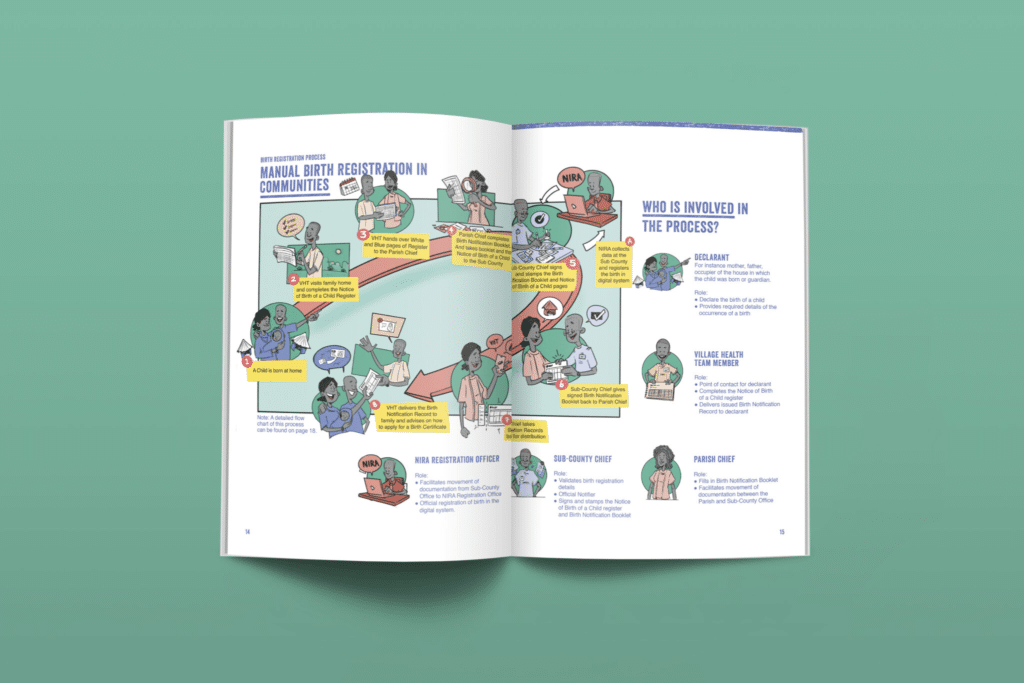
Three validated models were consolidated into a practical Business Case, supported by a comprehensive evaluation and clear recommendations for scale. Illustrated handbooks translated insights into step-by-step guidance, enabling frontline actors to replicate and sustain inclusive birth registration systems across diverse contexts.