01 Situation
NMB was running its insurance business on a system built for insurance companies not for a bank.
NMB Bank PLC, Tanzania’s largest bank by branch network, sells insurance through its 232 branches as part of its bancassurance operations. For years it relied on SmartPolicy, a legacy system designed for standalone insurers not for a bank acting as a distribution partner between customers and underwriters.
That mismatch showed up as everyday pain, not abstract complaints:
1. A quotation made in SmartPolicy had to be copied by hand into a separate document just so a customer could read it.
2. Customer details were typed once at the bank counter, then typed again into SmartPolicy with no way to keep the two in sync.
3. If a customer called about a claim, no one at the bank could see it. Staff had to call the insurer and ask on the customer’s behalf.
4. Policy documents lived in physical folders getting one meant a branch visit or an email chain
Launching a single new insurance product meant weeks of back-and-forth with the software vendor, every time.
None of this meant SmartPolicy was a bad system. It was the right system for the wrong kind of company. NMB needed something built specifically for a bank that sells insurance, and nothing like that existed anywhere in East Africa yet.
02 Assignment
A single system covering the entire bancassurance lifecycle designed around how NMB actually works.
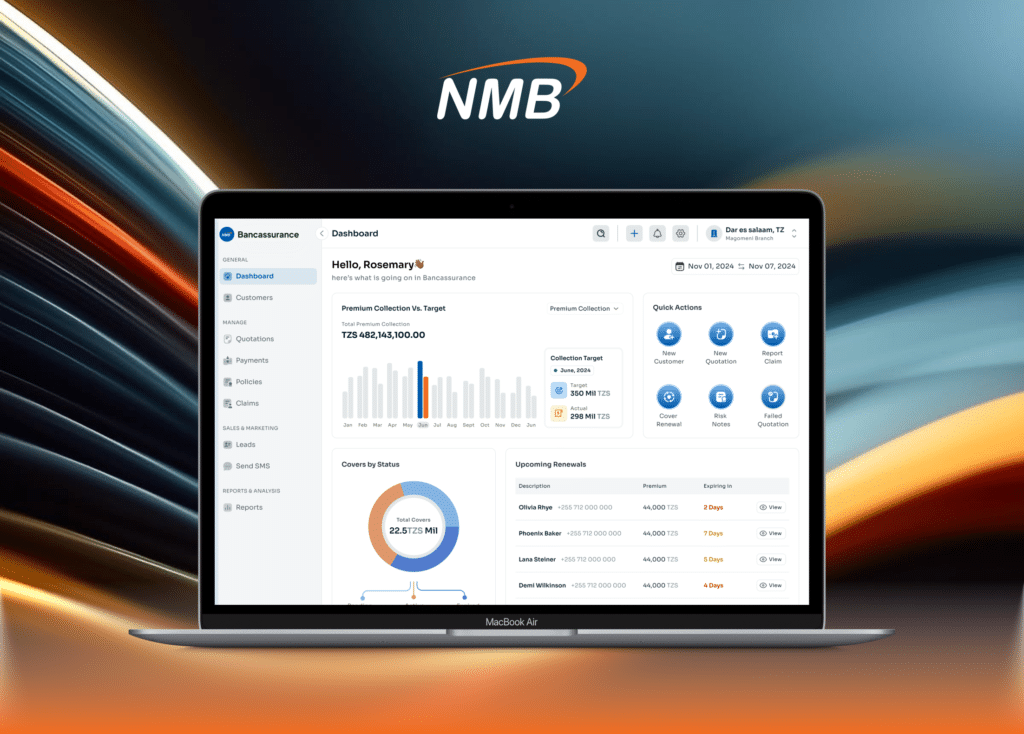
I was tasked to design the NMB Bancassurance System from the ground up: an 18-module enterprise platform spanning quotation creation, KYC onboarding, a no-code insurance product builder, payments, policy management, end-to-end claims, lead management, and automated customer communications.
03 Approach
Instead of guessing what NMB needed, we put 40+ people from every department in one room and let them tell us.
Before any design work started, I participated a discovery meeting with NMB where more than 40 people from different departments joined to explain their pain points first hand. Sales agents, operations, claims, finance, compliance, IT, and senior management were all present. That mix mattered. A system like this touches every one of those teams, and each one only sees its own piece of the problem.
To keep 40+ voices organised, we used the Value Proposition Canvas. It’s a simple method with two sides. On one side, you map the customer: what they are trying to get done, what frustrates them, and what would make their work better. On the other side, you map what you will build: what the product does, how it removes each frustration, and how it creates each gain. Here, the “customer” was every NMB team, and the “product” was the new system.
How the session worked:
Step 1, jobs: each department explained what they actually do all day.
Step 2, pains: each team explained what slows them down or goes wrong, in their own words.
Step 3, gains: each team described what a good day would look like.
Step 4, matching: with the pains and gains on the wall, we matched each one to a feature idea. Every pain needed a pain reliever, and every gain needed a gain creator. Anything that didn’t connect to a real pain or gain didn’t make it to our list.
What this gave us:
1. One shared picture. For the first time, every department saw the same wall of pains, and realised their frustrations were connected. Re-entering data in sales was causing reconciliation work in finance.
2. Priorities we could defend. Because the pains came from NMB’s own people, deciding what to build first was a conversation about evidence, not opinion.
3. Early buy-in. People who helped write the canvas wanted to see their pain solved. That made later reviews and testing easier, because the teams already felt ownership of the system.
4. A clear design brief. Pains like duplicate customers, hidden claim status, and vendor dependent products became the headline features of the final platform
The canvas became the thread running through the whole project. Whenever a design decision was unclear, we went back to the wall and asked one question: which pain does this solve, and which gain does it create?
04 Result
A system people actually use, and customers actually feel.
The platform shipped with two results we are proudest of: higher customer satisfaction, and an 80% cross-sell lead adoption rate. In plain terms, when the system showed an agent a chance to offer a customer another insurance product, the agent acted on it eight times out of ten.
Why adoption was so high?
Timing and placement. A cross-sell lead is only useful if it reaches the agent at the moment they can act on it. Most systems bury leads in a separate report that nobody opens. We did the opposite and treated when and where a lead appears as a design decision:
1. Right moment: leads show up when an agent is already with the customer, for example when a customer has just finished a quotation, a policy has been issued, or a renewal is coming up. The customer is engaged, and the conversation is already about insurance.
2. Right place: the lead sits inside the screen the agent is already working in, not on a separate page they have to remember to visit. One tap turns it into a quotation, with the customer’s details already filled in from the search-first lookup.
3. Right amount: each lead comes with a quality score and a short reason, so agents spend their time on the customers most likely to say yes, instead of scrolling a long list.
4. Right follow up: if a lead isn’t acted on, the system schedules a reminder, so no opportunity quietly goes cold.
Why customer satisfaction went up?
Customers feel the system even though they never log into it. Quotations were ready faster because nothing is typed twice. Claims can be checked by anyone at any time, with no call to the insurer needed. Automated messages keep them informed at every step. And the offers they receive are relevant to them, because they come from real signals like their banking activity and renewal dates, not random pitches.
What it means for NMB.
The bank now has a repeatable way to grow insurance sales from customers it already serves. Better timing and placement turned the lead module from a nice feature into a working sales engine, and satisfied customers are the reason those conversations keep going well.