01 Situation
Nepal’s 2021 census recorded an 11% slippage in sanitation progress after open-defecation-free declarations. A 2022 baseline across 42 local governments in Karnali province found 11% of households without toilets and 17% relying on temporary facilities.
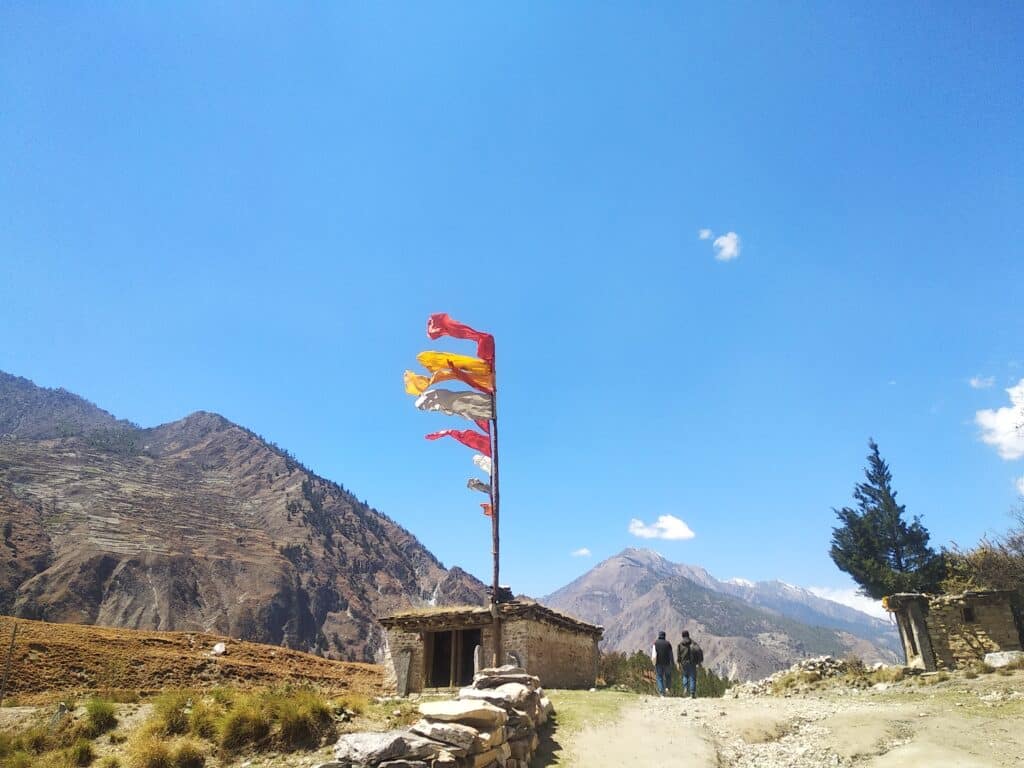
Karnali is among the hardest terrain in South Asia for sanitation delivery. Materials travel on mountain tracks. Water is scarce uphill. Skilled masons are few. Supply chains thin out well before the last village, and the products that do reach people are often unsuited to the conditions they must survive.
02 Assignment
A colleague at iDE Bangladesh and I were asked to mentor the iDE Nepal team in human-centred design, working alongside NIRAS Finland as the implementing technical assistance agency for SUSWA.
We came from iDE Bangladesh, where market-based sanitation had been taken to scale over several years. The brief was capability, not delivery: equip the Nepal team to understand their context, design their own response, and think commercially about how a solution reaches people at scale through markets rather than subsidies.
03 Approach
We worked through the process alongside the team rather than presenting conclusions to them.
The sequence covered three stages. First, using human-centred design to understand the problem rather than assume it, through field enquiry with households, masons, suppliers and local government. Second, applying a design-thinking mindset to generate and test options against what the research surfaced. Third, thinking through commercialisation: how a working product becomes an available product.
Prototyping took place in the remotest parts of Karnali and deliberately covered both halves of the problem. On the supply side, installing and testing portable, low-water sanitation options suited to mountain terrain and local artisan skill. On the demand side, prototyping the market development work itself, including promotional campaigns and advocacy approaches, because a product nobody knows about or wants is not a solution.
Our core job was to help the team see their own context clearly enough to arrive at a prescription that fitted it.
04 Result
The team’s deep dive identified the binding constraints: transport difficulty, low awareness, weak sanitation markets, product unavailability, and a shortage of skilled labour. Those findings, rather than a template, shaped what followed.
The Nepal team carried the work forward independently, through mason training, supplier coordination, establishment of supply outlets, and producer engagement, with pilot testing of portable sanitation options including SaTo products. The SUSWA team presented their approach and findings at World Water Week 2023.
Acknowledgement: With thanks to the SUSWA project, a bilateral initiative of the Governments of Nepal and Finland with EU co-funding, to NIRAS Finland, and to iDE Nepal, for the opportunity to contribute to sustainable, context-specific sanitation in remote Nepal alongside a skilled and genuinely curious team.